Refrigerant vs desiccant: which one for your room.
Both extract water from air. They do it in such different ways that the right answer is almost always obvious once you know the room temperature and the target RH.
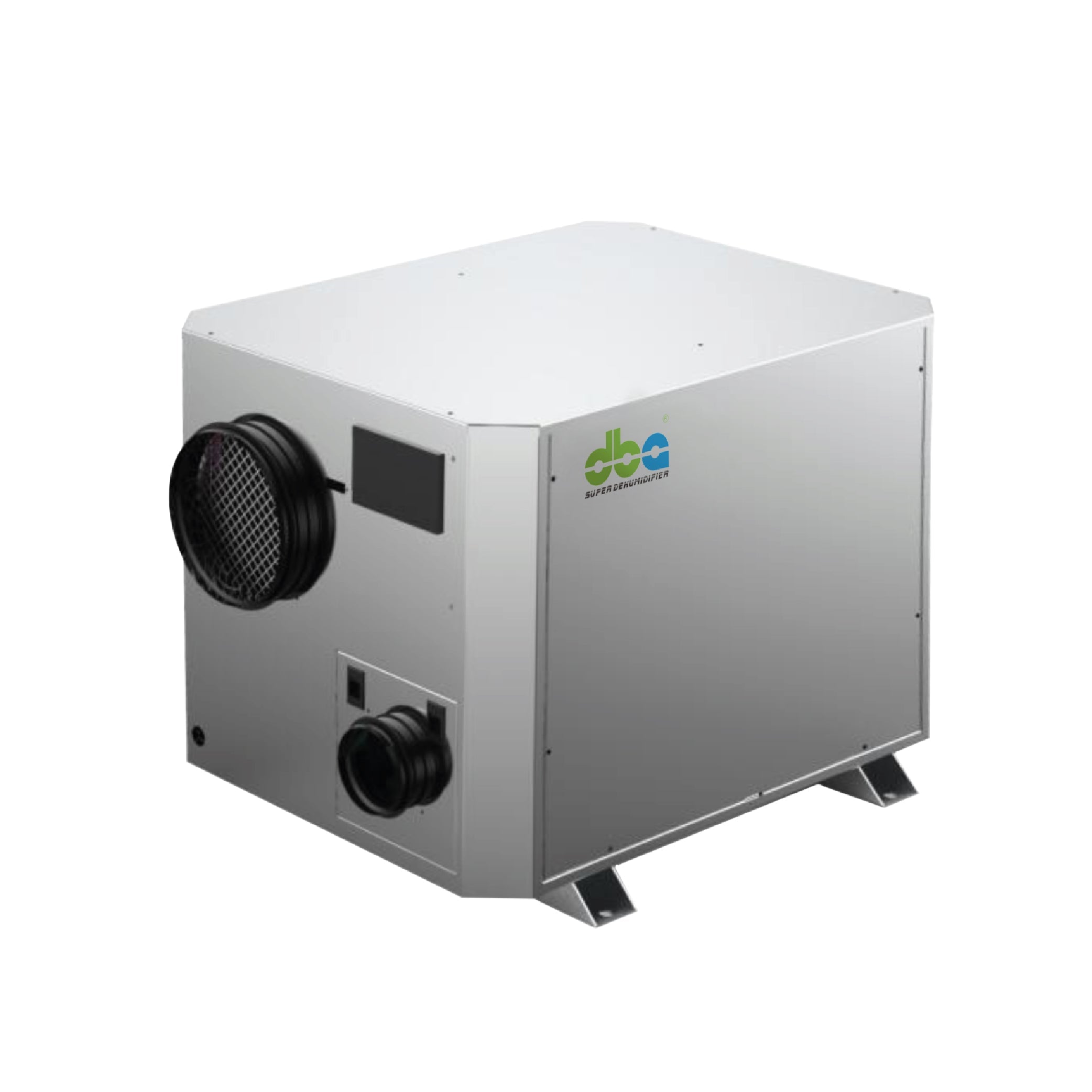
How a refrigerant unit works
A compressor pumps refrigerant through an evaporator coil. The coil is cold — usually 4–8°C in a working dehumidifier. Air passes over it, water in the air condenses on the cold fins, and the liquid drains away. The now-drier air passes over a hot condenser coil before returning to the room. Net effect: dry air at roughly the room temperature, with a small heat addition.
This is the technology in 95% of consumer and commercial dehumidifiers, and it is what every DBA-UTC, DBA-GEC, DBA-GE, and DBA-DH model uses. It is mature, cheap per litre extracted, and ideal in tropical climates.
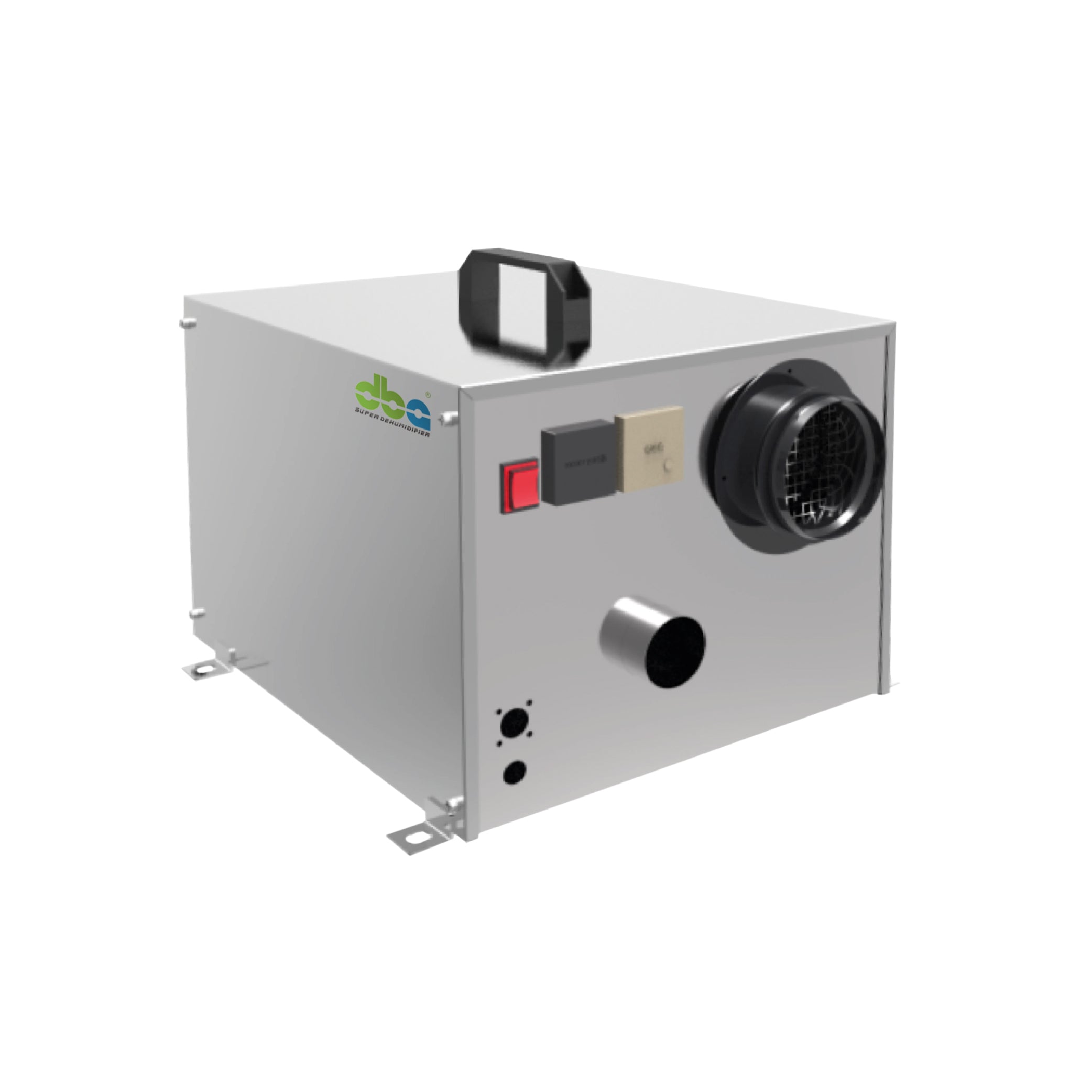
How a desiccant unit works
No compressor, no coil. Instead, a slowly rotating wheel made of silica honeycomb passes through the air stream. Silica adsorbs water vapour directly from the air — not by cooling, but by chemical attraction. The wheel keeps turning into a second air stream (reactivation air) heated by a PTC ceramic element. The heat drives the moisture off the wheel and out the reactivation exhaust. The wheel returns to the process side dry, and the cycle continues.
DBA's DD210, DD550, and DD850 use this principle. They look completely different inside from a refrigerant unit — more like a small air handler with a rotating cartridge.
Where the choice splits
The deciding variable is temperature.
- Above 10°C: refrigerant wins on cost, energy per litre, and capacity per dollar.
- 5–10°C: refrigerant still works but loses 30–50% capacity. Desiccant becomes competitive.
- 0–5°C: refrigerant struggles — coils frost over, the unit spends as much time defrosting as drying. Desiccant takes over.
- Below 0°C: refrigerant is unusable. Only desiccant works.
The second variable is target RH:
- Above 40% RH: refrigerant comfortable.
- 30–40% RH: refrigerant works but loses efficiency; LGR variants (like the GEX range) are designed for this band.
- Below 30% RH: refrigerant cannot reach the setpoint at all. Desiccant required.
Singapore use cases
For homes, offices, retail, restoration, gallery climate control in normal conditions — refrigerant every time. Singapore ambient sits in the sweet spot for refrigerant technology: warm, humid, easy to condense. The DBA-UTC, GEC, and HC ranges cover essentially every conventional application.
The desiccant exceptions in Singapore:
- Cold rooms and walk-in freezers for food, pharmaceutical, or chemical storage at 2–8°C or below
- Lithium-ion battery production and storage requiring <1% RH dew points
- Pharmaceutical packing lines with FDA-style validated RH bands of 20–35%
- Lyophilisation (freeze-drying) rooms in food and biotech
- Server and switchgear rooms at low ambient where occasional condensation risk needs eliminating entirely
What you pay for the difference
Per litre of water removed, a desiccant unit uses 2.5–3.5× more electrical energy than a refrigerant unit at the same conditions. That sounds bad until you remember that a refrigerant unit at −5°C uses an infinite amount of energy per litre (it does not work). The right comparison is not desiccant against refrigerant in tropical air — it is desiccant against doing nothing because refrigerant cannot work.
Capital cost is also higher. A 1 kg/hr desiccant DD210 sits in a different price tier from a comparable refrigerant unit, partly because the silica wheel is a premium component and partly because the volumes are lower.
Quick decision tree
Room temperature 10°C or above → refrigerant.
Room temperature 5–10°C → either; refrigerant unless RH target is below 40%.
Room temperature below 5°C → desiccant.
Target RH below 30% → desiccant.
Anything else → refrigerant.
Hybrid systems
For large industrial spaces with strict RH targets at low ambient (think a 1,000 m² cold room at 4°C and 35% RH), the most efficient setup is often hybrid: a refrigerant pre-dryer drops humidity to 50%, then a desiccant post-dryer polishes it down to setpoint. Each unit operates in the band where it is most efficient. We design these as project-grade systems, not off-the-shelf units.
If you are unsure which side of the line you fall on, send us the ambient temperature, target RH, room dimensions, and how the space is used. We will tell you within a working day which family of unit fits and roughly what it costs.
Talk to us
Not sure which technology your space needs?
Tell us the room temperature, target RH, and how it is used. We will recommend a unit and quote it.
Request a quote