Ducting a ceiling dehumidifier without choking it.
A ceiling dehumidifier is a fan with a refrigeration circuit attached. Add too much duct and the fan loses; capacity collapses, condensate stops, and you have an expensive box humming away to no effect.
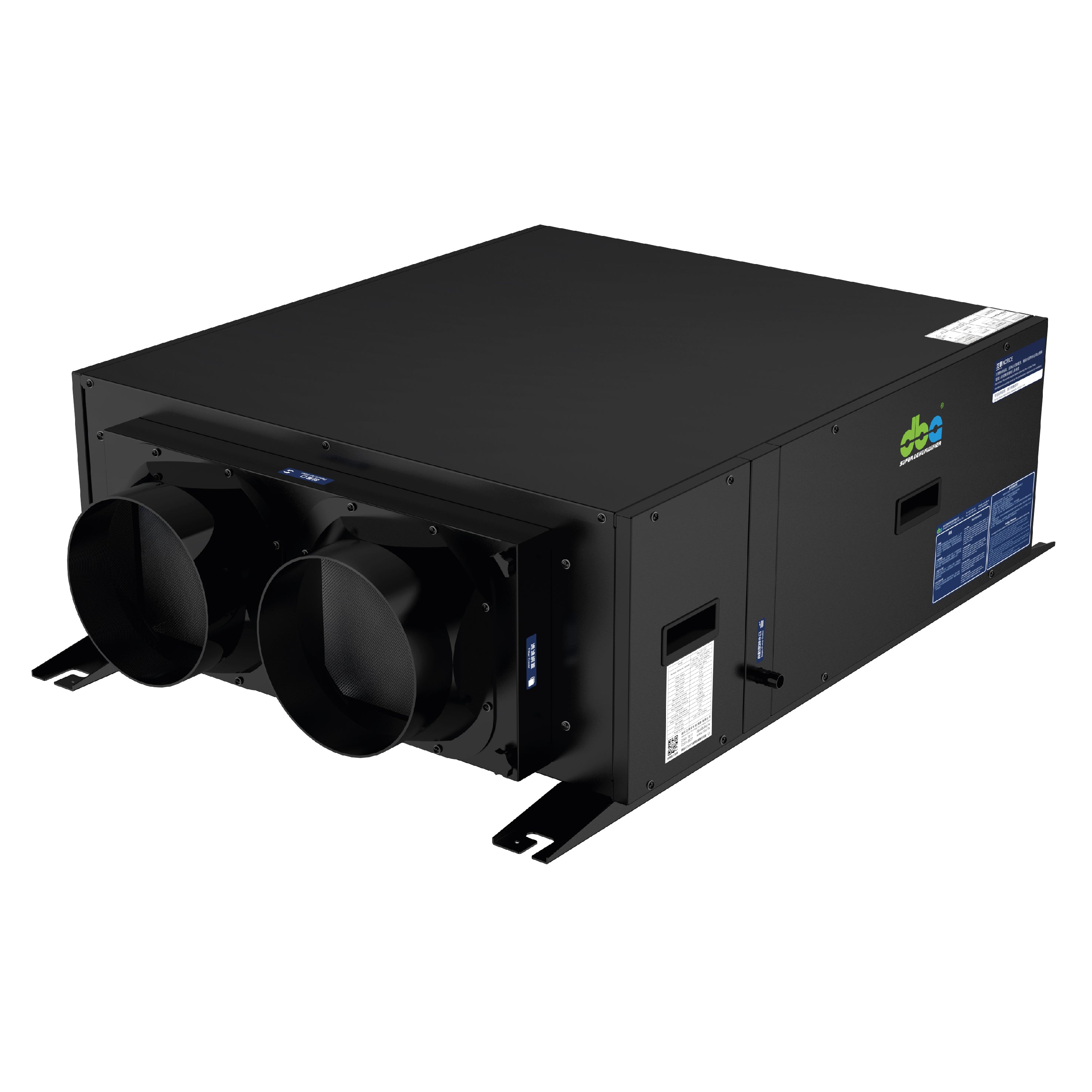
The single most useful concept here is external static pressure — the resistance the fan has to push against once you bolt your ducting on. Every model has a rated maximum. UTC ultra-slim ceiling units sit around 30–40 Pa. The commercial GEC range pushes higher, 80–150 Pa depending on capacity. Go over that and airflow falls off a cliff; go under it and you have spare capacity to play with for longer runs or extra grilles.
The static pressure budget
Treat it as a budget you spend down. Sources of pressure loss:
- Straight duct — flexible insulated duct loses roughly 1–2 Pa per metre at typical airflows. Spiral rigid duct is half that.
- Bends — a 90° bend in 200 mm flex duct costs about 10–15 Pa. A long-radius rigid bend is 3–5 Pa.
- Supply grilles — a free-area grille at design flow costs 5–15 Pa. A linear diffuser, more.
- Return grille — usually 10–20 Pa on the dirty side, plus filter.
- Filter — clean: 20 Pa. Dirty: easily 60 Pa. Always design with the filter at its replacement point, not its day-one reading.
Add them up. If your total is comfortably below the unit's rated max, you have room. If it is close, you are going to lose capacity to the duct, and you should either go up a model size or shorten the run.
Sizing the duct itself
The rule of thumb for low-pressure dehumidifier ducting is to keep velocity below 4 m/s. Higher and you generate noise and pressure loss for no benefit. Use the rated airflow of your unit and divide:
| Unit airflow (CMH) | Velocity at 4 m/s | Suggested duct diameter |
|---|---|---|
| 220 (UTC20) | — | 150 mm |
| 500 (UTC68 / GEC68) | — | 200 mm |
| 890 (UTC120) | — | 250 mm |
| 1,200 (GEC145) | — | 300 mm |
| 1,700 (GEC280) | — | 350 mm |
Branch ducts can step down once the airflow they carry drops. Two 150 mm branches off a 250 mm trunk is a reasonable layout for a two-zone UTC120 install.
Layout: where the air should actually go
Air takes the path of least resistance. If one branch is 2 m long and another is 8 m, most of the supply will go down the short one unless you balance it. Two practical defences:
- Keep branch lengths within ±30% of each other where possible
- Fit a manual balancing damper on every branch — even cheap iris dampers are fine for residential use
Return air — the half people forget
Every cubic metre going out the supply has to come in through the return. A ducted dehumidifier without a properly sized return grille will run hot, trip on internal temperature, and short-cycle. Match the return grille free area to at least the duct cross-section, and place it where you will actually pull the moist air the unit is meant to treat — high up in a corner, not in a hallway dead zone.
Throw and grille choice
Supply grilles are not just air outlets — they aim air. The throw distance (the horizontal reach of the supply stream at 0.25 m/s) decides how well the room mixes. Aim for throw = room length × 0.7. Short throw and air stalls beside the grille; long throw and you blast a wall.
For 3 m rooms in residential Singapore, a 4-way ceiling diffuser is the easiest answer. For long open-plan offices, linear slot diffusers thrown along the room axis work better.
Field note
If you can hear air whistling at the grille, you are above 4 m/s. Open the damper, go up a grille size, or both. Whistling rooms become noise-complaint tickets within two weeks.
Insulation
Singapore plenums sit at 28–35°C with high humidity. Ductwork carrying dehumidified air at 18–22°C will sweat on its outer surface if it is not insulated. Use insulated flex duct or wrap rigid duct with closed-cell foam. The cost is small; the alternative is a damp ceiling.
A simple sanity check
Before you order anything, draw the ducting out on the architectural plan. Mark duct lengths, bends, grilles, and the static pressure cost of each. If your spreadsheet total is under 70% of the unit's rated static, you are safe. If it is above 90%, you are buying trouble. Between 70 and 90% is where most well-designed installs sit.
If you would like us to size the ducting on a project, send us the floor plan and a section through the ceiling void and we will model it. Often we send back a layout you can hand straight to your M&E contractor.
Get help with your project
Want the duct layout drawn for you?
Send us the floor plan and section. We will size the unit, draw the duct, and quote it as one package.
Request a quote